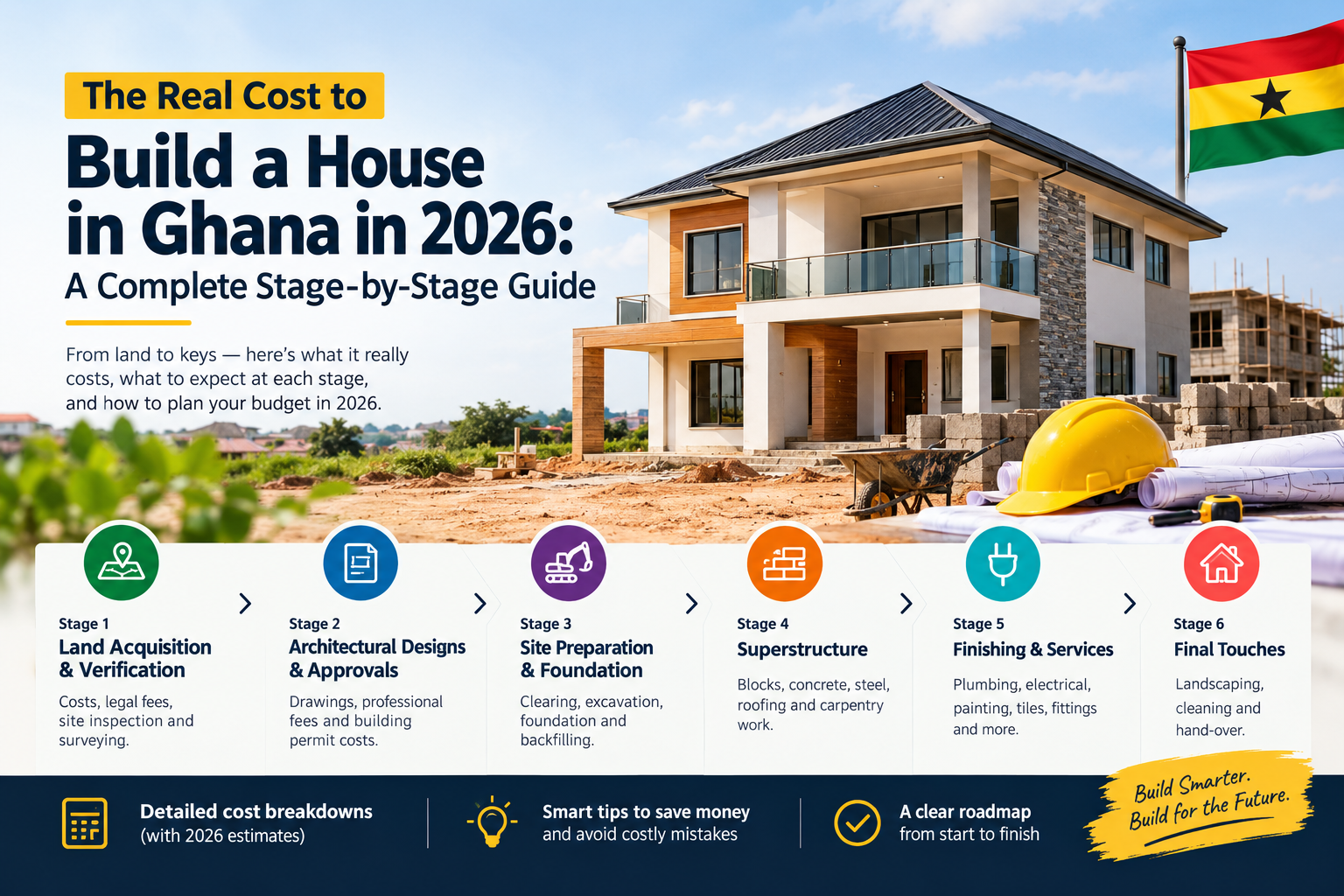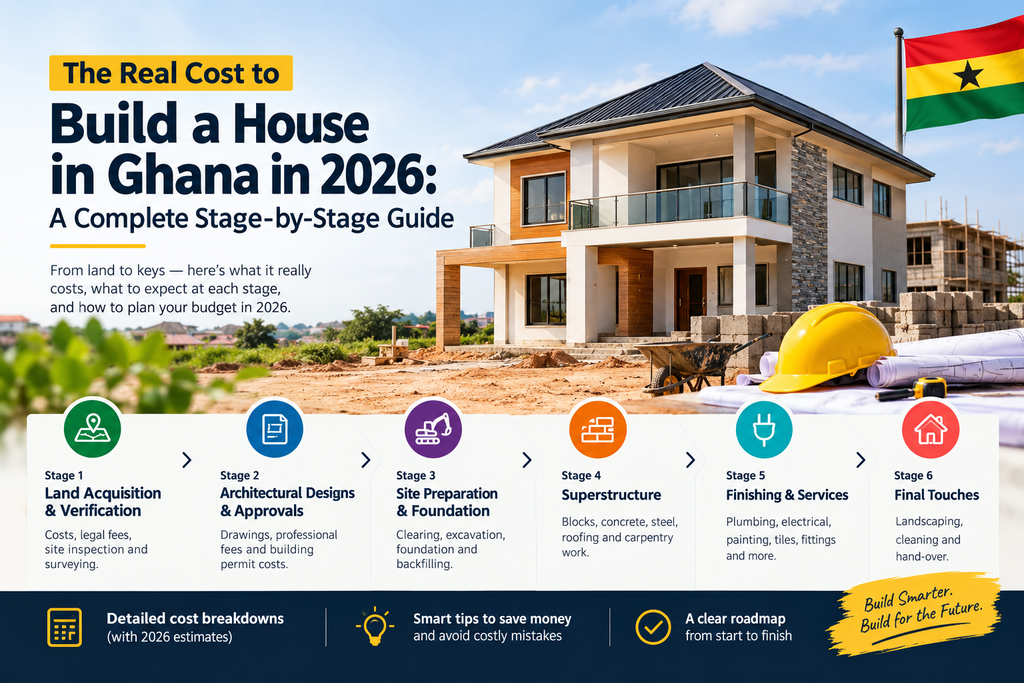
The cost to build a house in Ghana in 2026 typically falls between GH₵750,000 and GH₵2.5 million for a standard 3-bedroom home, excluding land — and self-build projects that skip proper cost estimation commonly run 30–50% over budget. If you’re trying to work out the real cost to build a house in Ghana before you commit to a plot or a contractor, this guide breaks it down stage by stage.
The figures below are 2026 estimates for Accra and the surrounding areas, based on current material, labour, and professional fee rates. Costs in Kumasi, Takoradi, and other regional centres tend to run 10–20% lower, mainly because land and labour are cheaper outside the capital. Every project is different, so treat these numbers as a planning baseline — not a fixed quote — and speak to Adinvec’s construction team for a site-specific estimate before you finalise your budget.
What Affects the Cost to Build a House in Ghana
Before looking at figures, it helps to understand why two houses of similar size can have a very different cost to build.
Location (Accra vs Kumasi vs Tema vs Secondary Cities)
Land prices, labour rates, and transport costs for materials all vary by region. Building in Accra or Tema generally costs more than Kumasi, Takoradi, or smaller towns, mainly because of higher land values and demand for skilled labour. If budget is tight, building outside the capital — while still working with a contractor who can supervise remotely — is one of the simplest ways to bring the cost to build a house in Ghana down.
House Size and Design Complexity
Cost is usually estimated per square metre, so size has the single biggest impact on the total. A simple rectangular single-storey design with standard room layouts costs noticeably less per square metre than a multi-storey house with irregular shapes, large open spans, or elaborate rooflines.
Finish Level (Economy vs Standard vs Premium)
The structural shell — foundation, walls, and roof — accounts for a relatively fixed share of cost. What moves the budget most is the finish: economy tiles versus imported porcelain, standard doors versus solid wood, basic sanitary fittings versus premium brands. Finishing typically makes up 25–35% of total build cost, and it’s the stage where budgets most often creep upward.
Imported vs Local Materials and the Cedi Exchange Rate
An estimated 70–80% of Ghana’s building materials are imported or have import-linked pricing — tiles, sanitary ware, electrical fittings, roofing sheets, and much of the steel and glass used in construction. That means your budget is exposed to cedi–dollar exchange rate movement, which you can track directly on the Bank of Ghana’s exchange rate page. Locally produced materials — blocks, sand, aggregates, and some cement — are more stable in price and worth prioritising wherever quality allows.
Land Costs (Before You Build)
Land is usually the first major expense, and in cities like Accra it can rival or exceed the cost of the building itself.
Average Land Prices by Region
Prices vary enormously by neighbourhood and proximity to major roads or amenities. As a rough guide:
| Area | Approximate price range (per plot) |
|---|---|
| Prime Accra suburbs (East Legon, Airport Residential, Cantonments) | GH₵400,000 – GH₵2,000,000+ |
| Emerging Accra suburbs (Oyarifa, Adenta, Tema Community areas) | GH₵100,000 – GH₵400,000 |
| Kumasi and regional capitals | GH₵60,000 – GH₵250,000 |
| Smaller towns and peri-urban areas | GH₵20,000 – GH₵100,000 |
Always verify current prices with a licensed surveyor or real estate professional in your target area — these ranges shift quickly as infrastructure develops.
Documentation and Title Registration Costs
Beyond the purchase price, budget for:
- Site plan and cadastral registration
- Indenture preparation and legal fees
- Land title registration with the Ghana Lands Commission
- Due diligence / land search fees to confirm the seller’s title
Together, these typically add GH₵5,000 – GH₵25,000, depending on the property value and how quickly you need the process completed. Never skip due diligence — land disputes are one of the most common and costly problems for self-builders in Ghana.
Stage-by-Stage Construction Cost Breakdown
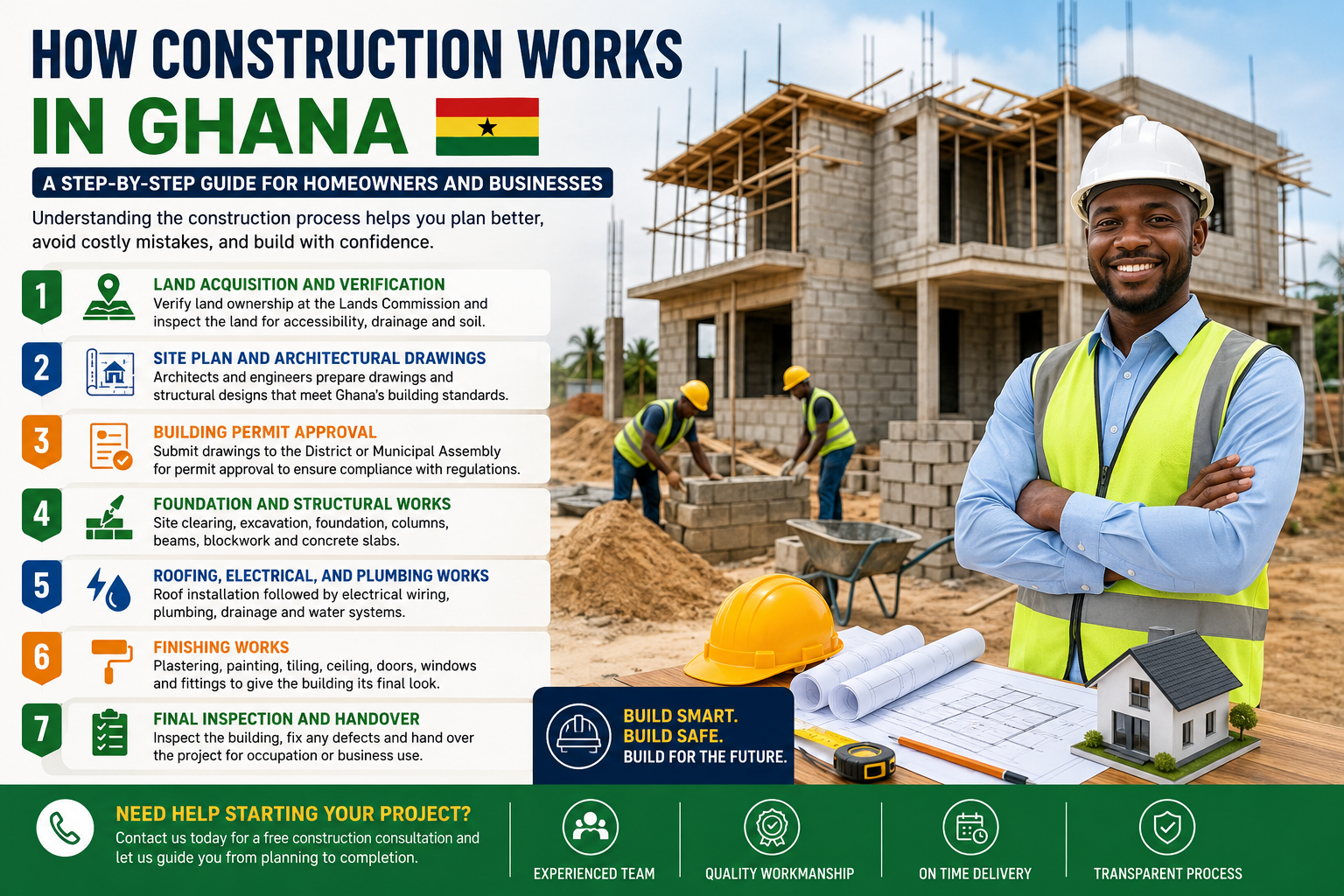
This is where most of your budget goes. Figures below are 2026 estimates for a standard 3-bedroom house (roughly 120–150 m²) with a mid-range finish in the Accra area — the same stages our project consultation and estimation team walks clients through before construction starts.
| Stage | Estimated cost (GH₵) | Notes |
|---|---|---|
| Foundation and substructure | 80,000 – 200,000 | Varies significantly with soil type and whether piling is required |
| Superstructure / building shell | 200,000 – 450,000 | Walls, columns, beams, and roof structure |
| Roofing | 80,000 – 200,000 | Aluminium sheeting is more affordable; tiles and long-span options cost more |
| Electrical installation | 40,000 – 100,000 | Wiring, distribution boards, fittings, and outlets |
| Plumbing | 35,000 – 80,000 | Pipework, fittings, water storage, and drainage |
| Tiling and finishing | 80,000 – 200,000 | Floor and wall tiles, screeding, painting |
| Doors, windows, and fittings | 60,000 – 150,000 | Wide range depending on material — wood, aluminium, or uPVC |
Foundation and substructure: Highly site-dependent. Sloped or waterlogged plots, or sites requiring soil testing and piling, can push this figure well above the range shown.
Superstructure / building shell: Typically the single largest line item, since it includes structural steel and the bulk of the cement and block work.
Roofing: Material choice matters enormously — a basic aluminium roof and a clay tile roof of the same size can differ in cost by 50% or more.
Electrical and plumbing: Often underestimated by first-time builders. Get a detailed schedule of fittings from your contractor rather than a lump-sum guess.
Tiling and finishing: The widest cost range of any stage, because it’s driven almost entirely by material choice rather than labour.
Professional Fees and Hidden Costs
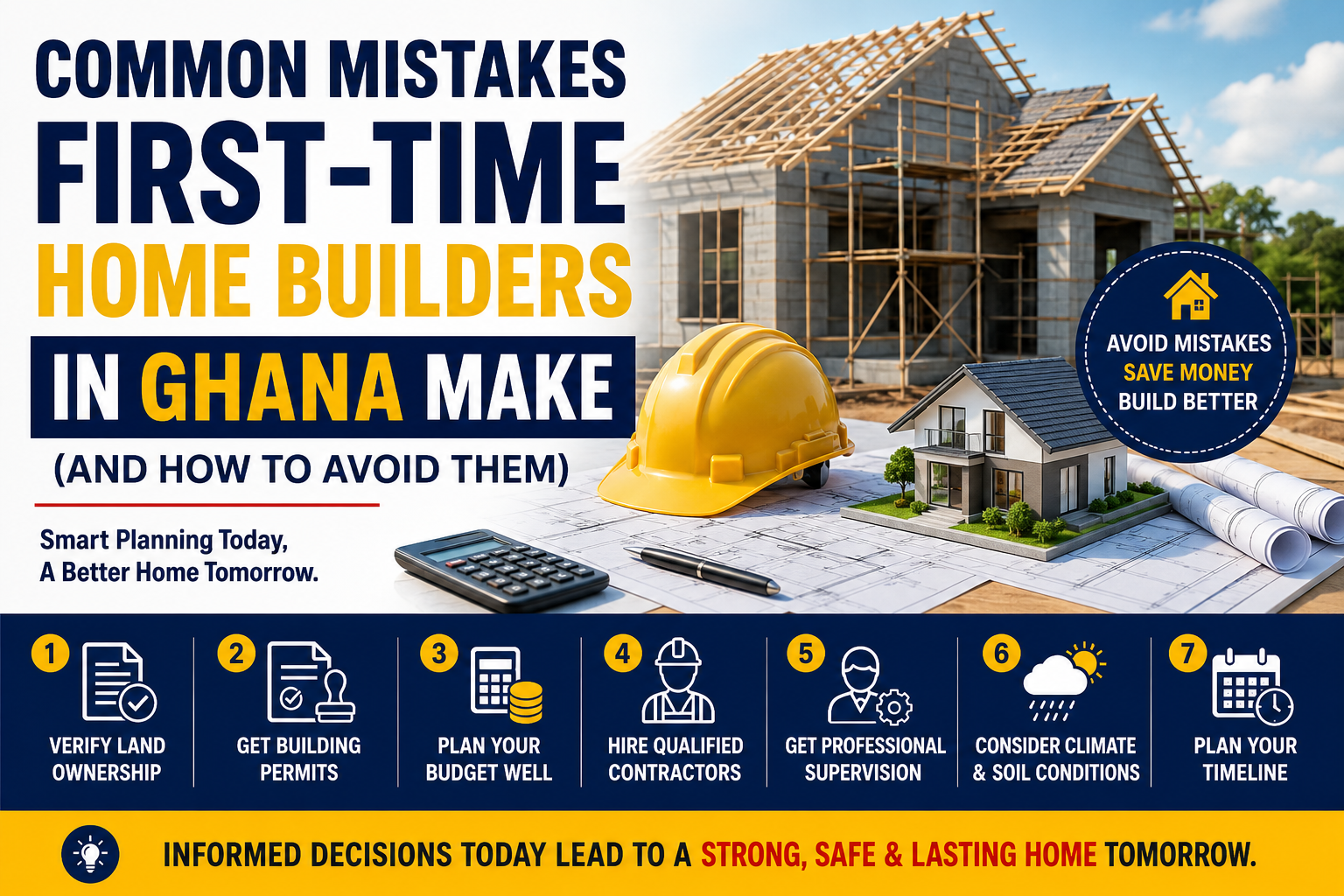
A common mistake self-builders make is budgeting only for materials and labour, and forgetting professional and regulatory costs.
Architect, Structural Engineer, and Quantity Surveyor Fees
Combined professional fees for architectural design, structural engineering, and quantity surveying typically run 4–8% of total construction cost for a standard residential project — higher for complex or multi-storey designs. On a GH₵1 million build, that’s roughly GH₵40,000 – GH₵80,000. Always confirm that your architect is registered with the Architects Registration Council of Ghana before signing a contract. This is not a cost to cut — proper design and an accurate Bill of Quantities are what prevent the biggest budget overruns later.
Planning Permission and Utility Connection Fees
Building permits from your local Metropolitan, Municipal, or District Assembly (MMDA) typically cost GH₵2,000 – GH₵15,000, depending on the size of the building and the district’s fee schedule — some districts charge a percentage of project value, others a flat rate by size. Add utility connection fees for electricity (ECG) and water (GWCL), which vary by location and distance from existing infrastructure.
Contingency Budget — Why 10–15% Matters
Material prices, exchange rates, and site conditions can all shift mid-project. A contingency of 10–15% of total construction cost should be built into every budget from day one — not added as an afterthought when costs start climbing. Projects that skip this step are the ones most likely to stall halfway through.
Total Cost to Build a House in Ghana: Full Project Range
Economy vs Premium Build Comparison
| Finish level | Approximate total (excl. land), 3-bedroom, ~120–150 m² |
|---|---|
| Economy (basic finishes, simple design) | GH₵600,000 – GH₵900,000 |
| Standard (mid-range finishes, common in Accra) | GH₵900,000 – GH₵1,800,000 |
| Premium (imported finishes, complex design) | GH₵1,800,000 – GH₵3,000,000+ |
Sample Budget: 3-Bedroom House in Accra
For a standard-finish 3-bedroom house on an already-owned plot in an Accra suburb, the full cost to build a house in Ghana breaks down roughly like this:
- Construction (all stages): GH₵750,000 – 1,200,000
- Professional fees (5%): GH₵37,500 – 60,000
- Permits and utility connections: GH₵5,000 – 15,000
- Contingency (12%): GH₵90,000 – 144,000
- Estimated total: GH₵880,000 – 1,420,000
Add land cost separately based on your chosen area — in many parts of Accra, that can add another GH₵200,000 – GH₵1,000,000+ to the full project. You can browse examples of completed builds on Adinvec’s projects page to see how these budgets translate into finished homes.
How to Avoid Budget Overruns
Milestone-Based Payments vs Lump Sum Contracts
Paying a contractor a single lump sum up front is one of the biggest risk factors in Ghanaian self-build projects. Structuring payment against completed, verified milestones — foundation complete, shell complete, roofing complete, and so on — keeps your money tied to visible progress and gives you leverage if work stalls or quality slips.
Working With a Licensed Contractor and Independent Site Supervision
Projects supervised only by the person paying for them, with no independent technical oversight, are far more prone to cost overruns, rework, and disputes over quality. An independent site supervisor or quantity surveyor — even engaged part-time — pays for themselves by catching problems and cost inflation early, before they compound.
Get an Accurate Estimate for Your Project
These figures are a planning starting point, not a substitute for a proper site-specific estimate. Every plot, design, and finish level changes the true cost to build a house in Ghana — and getting it wrong at the budgeting stage is the single biggest cause of stalled or over-budget builds.
Adinvec’s Project Consultation & Estimation service gives you a detailed, itemised cost breakdown before you break ground, so you know exactly what your build will cost at every stage.